
Pelvic Floor Physical Therapy for Erectile Dysfunction: What the Research Shows

Part 1 of 2. Part 2 covers shockwave therapy for the vascular side of ED.
When most men research erectile dysfunction, they land in one of two places: medication, or a vascular procedure like shockwave. Almost nobody tells them there's a muscular piece to this too, one that a pelvic health physical or occupational therapist is specifically trained to evaluate. That gap in what men actually hear about is a real part of why so many live with this for years before finding the right care.
An Erection Depends on More Than Blood Flow In
Getting and keeping an erection requires a few things to work together: adequate arterial blood flow into the penis, a nervous system that's coordinating the response correctly, adequate testosterone, and one piece most men never hear: the muscles that physically compress and trap that blood once it's there. Medication targets the blood flow to the penis. It does nothing for the muscular component.
The Muscles Doing More Work Than You'd Guess
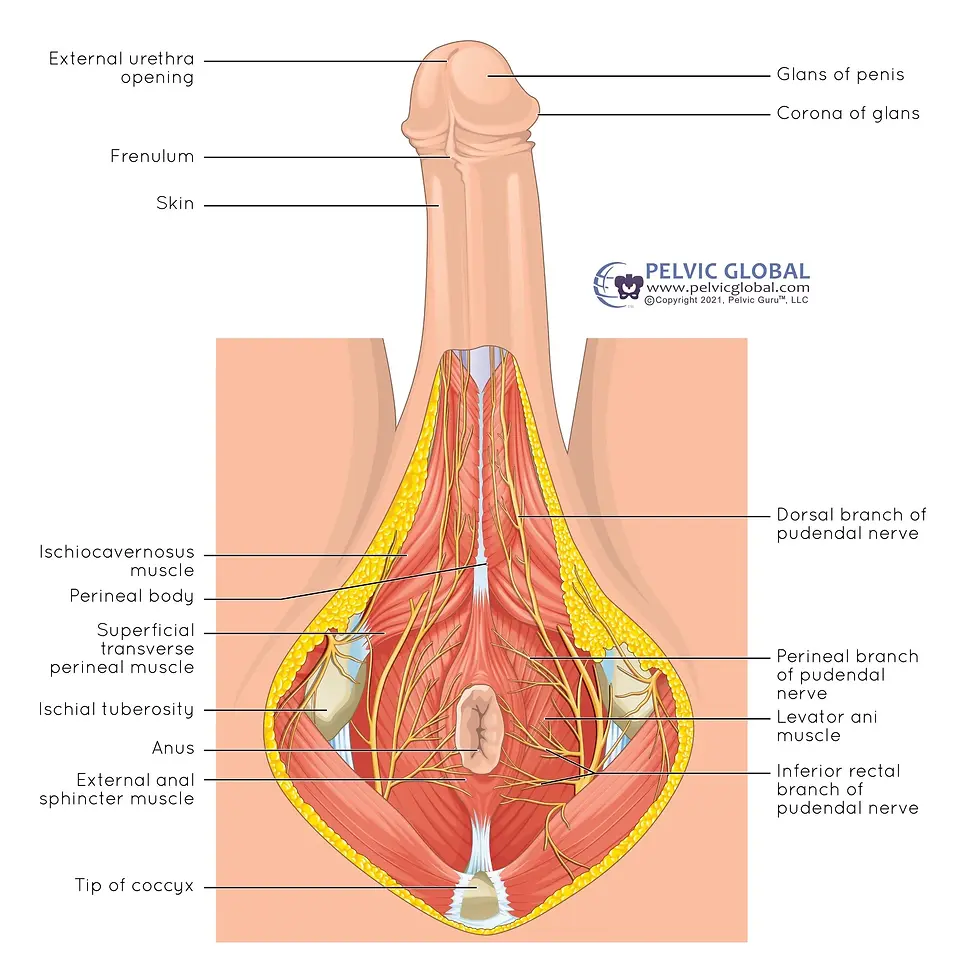
Two specific pelvic floor muscles, the bulbospongiosus and ischiocavernosus, sit right at the base of the penis. The bulbospongiosus increases pressure inside the erectile tissue, helping trap blood in the shaft. The ischiocavernosus compresses the arteries at the base, adding to rigidity. These are ordinary skeletal muscles. Like any other muscle group, they can be weak, they can be overactive and restricted, and either problem can show up as the same complaint: a man telling you he can get partially there but can't stay firm, or can't get there at all.
That's the piece a pelvic floor evaluation is built to find. Not a generic exercise handout, an actual assessment of what your specific muscles are doing.
Not Every Pelvic Floor Needs to Get Stronger
This is the part that surprises most men. If the pelvic floor muscles are weak, strengthening helps. But just as often, especially when erectile dysfunction shows up alongside pain in the pelvis, back or hips, tension in these areas, or painful ejaculation, the muscles are already too tight and short, and more Kegels make it worse. The treatment in that case looks completely different: manual therapy, myofascial release, breathing retraining, and hip and abdominal mobility work aimed at getting an overactive muscle to relax, not squeeze harder. Getting this distinction right, weak versus overactive, is the entire point of being evaluated by someone trained in this specifically, rather than guessing.
What the Research Shows
The foundational trial here is a randomized controlled trial published in the British Journal of General Practice in 2004. Fifty-five men with erectile dysfunction lasting six months or longer were split into a pelvic floor muscle training and biofeedback group versus a lifestyle-advice-only control group. At three months, the treatment group's erectile function score improved by 6.74 points on the standard IIEF scale, a statistically significant jump, while the control group showed no meaningful change. At final assessment, 40 percent of participants had normal erectile function restored, another 34.5 percent had improved, and 25.5 percent saw no change.
A 2020 randomized controlled trial in Sexual Medicine looked specifically at men undergoing radical prostatectomy, where erectile dysfunction is an expected and often distressing side effect. Ninety-seven men were split between an intensive pre-surgery pelvic floor training protocol and standard care. The intensive group reported meaningfully less distress and better quality of life in the early weeks after surgery. The study's own authors note it wasn't large enough to definitively prove long-term erectile function gains within its 12-week window, worth saying plainly rather than overselling it.
A 2025 narrative review in the International Journal of Impotence Research pulled together 26 studies, 14 of them randomized controlled trials, on pelvic physical therapy for male sexual disorders. Its conclusion: pelvic floor physical therapy significantly improves erectile function in men with mild-to-moderate ED, and better pelvic floor muscle relaxation and control directly improves blood circulation to the penis, the exact mechanism described above.
Why This Is Bigger Than the Bedroom
A 2019 systematic review and meta-analysis in the Journal of Sexual Medicine found that erectile dysfunction commonly predates a first heart attack by two to five years, and that a large share of men who survive a heart attack had at least mild ED beforehand. ED is often an early signal of vascular health problems showing up in the smallest blood vessels first, before they show up anywhere else. That's a real reason to get this evaluated rather than just quietly managed around, whatever the treatment path ends up being. ED can be an important warning sign that you need to jump start your health and wellness.
Peyronie's Disease: Matching the Modality to What's Actually Wrong
Peyronie's disease often comes up in the same conversation as erectile dysfunction. Fibrous scar tissue, called a plaque, forms inside the shaft of the penis, causing curvature, indentation, pain, and frequently ED alongside it. It's a different condition from straightforward vasculogenic ED, and the evidence behind each of our modalities isn't uniform here, so it's worth being precise about what actually does what.
Therapeutic ultrasound has the most specific, strongest research behind it for this particular condition. A randomized controlled trial published in the Journal of Rehabilitation Therapy in 2020, from the same research team behind the pelvic floor and prostatectomy study above, treated men with 12 sessions of therapeutic ultrasound over four to six weeks. The results: a significant reduction in plaque thickness, a 38 percent average reduction in curvature angle, and a meaningful improvement in erectile function score. This is a treatment we deliver in-house, not something we're describing secondhand.
Class IV laser is also part of how we approach Peyronie's disease. Our laser includes a dedicated wavelength for scar tissue, directly relevant to the fibrous plaque involved in Peyronie's. The human research here is earlier stage than the ultrasound evidence. A small randomized pilot study and a separate trial combining low-intensity laser with shockwave have both reported positive early results, but neither is large enough yet to call this an established standard on its own.
Pelvic floor physical therapy's role here is more supportive than curative. A 2023 Cochrane review, the highest bar of evidence in medicine, looked at non-surgical Peyronie's treatments broadly and concluded there's limited evidence behind most of them. That review wasn't specific to manual PT, but it's an honest reminder not to oversell any single modality here. What PT does reliably help with is the muscular guarding, pain patterns, and coexisting erectile or ejaculatory symptoms that come along with Peyronie's, alongside whatever plaque-directed treatment is being used.
Shockwave needs a more careful claim here than it does for straightforward ED. A 2023 systematic review and meta-analysis in BMC Urology found shockwave therapy significantly reduces plaque size and pain, but found no significant effect on curvature or erectile function. That's a meaningfully different result than shockwave's track record for vasculogenic ED, covered in Part 2 of this series, and we want to be direct about that difference rather than blur the two.
In practice, Peyronie's is rarely a one-modality case. Because it usually shows up with more than one issue at once, curvature, pain, plaque, and often ED, the right approach is typically a combination matched to what we find on evaluation, not a single default protocol.
What Evaluation and Treatment Look Like at RVA Holistic PT
We start with a full-body evaluation, not just a local one. That means looking at how you move, breathe, stand, and carry tension through your hips and spine, the same way we'd evaluate any orthopedic complaint, before assessing the pelvic floor muscles themselves, externally and internally where appropriate, always at your pace. From there, treatment is matched to what we actually find. That might mean a strengthening program if the muscles are weak, or manual therapy, dry needling, and relaxation-based breathing work if they're overactive and restricted. Class IV laser is available as part of your session at no extra charge (when clinically appropriate), and it's worth being direct about where the evidence stands here: early research on photobiomodulation and erectile function, including animal studies on diabetic and age-related ED, is promising, but it hasn't yet been tested in the kind of human clinical trials that back pelvic floor muscle training. We use it as a supportive adjunct within your broader plan.
Who This Helps, and Where Shockwave Comes In
Pelvic floor physical therapy is the right starting point when the driver is muscular or neuromuscular: weak or overactive pelvic floor muscles, post-prostatectomy rehabilitation, or ED tied to pelvic pain and painful ejaculation. When the primary driver is vascular damage to the erectile tissue itself, arteries that aren't delivering enough blood flow regardless of muscle function, that's where shockwave therapy becomes the more direct tool. We cover the research on that in Part 2 of this series. For a lot of men, the honest answer is both, addressed as one coordinated plan rather than two separate guesses.
What This Costs
A pelvic therapy evaluation is a full hour with a specialized pelvic PT or OT. Full pricing is always disclosed before you start, no surprises.
If you're dealing with erectile dysfunction, whether it's new or something you've been quietly managing for years, it's worth finding out what's actually driving it before assuming you know. Reach out through our contact form and our team will get you scheduled with the right therapist for this.
Kelley Ryan, PT, DPT, WCS, PCES
RVA Holistic PT
References
Dorey G, Speakman M, Feneley R, Swinkels A, Dunn C, Ewings P. Randomised controlled trial of pelvic floor muscle exercises and manometric biofeedback for erectile dysfunction. Br J Gen Pract. 2004;54(508):819-825.
Milios JE, Ackland TR, Green DJ. Pelvic Floor Muscle Training and Erectile Dysfunction in Radical Prostatectomy: A Randomized Controlled Trial Investigating a Non-Invasive Addition to Penile Rehabilitation. Sex Med. 2020;8(3):414-421. doi:10.1016/j.esxm.2020.03.005
Sahin E, Brand A, Cetindag EN, Messelink B, Yosmaoglu HB. Pelvic physical therapy for male sexual disorders: a narrative review. Int J Impot Res. 2025;37(12):941-949. doi:10.1038/s41443-025-01034-5
Zhao B, Hong Z, Wei Y, Yu D, Xu J, Zhang W. Erectile Dysfunction Predicts Cardiovascular Events as an Independent Risk Factor: A Systematic Review and Meta-Analysis. J Sex Med. 2019;16(7):1005-1017. doi:10.1016/j.jsxm.2019.04.004
Yang et al. Effect of near-infrared laser treatment on improving erectile function in rats with diabetes mellitus. Andrology. 2023.
Milios JE, Ackland TR, Green DJ. Peyronie's disease and the role of therapeutic ultrasound: a randomized controlled trial. J Rehabil Ther. 2020;2(2).
Wang X, Liu H, Tang G, Wu G, Chu Y, Wu J, Cui Y. Updated recommendations on the therapeutic role of extracorporeal shock wave therapy for Peyronie's disease: systematic review and meta-analysis. BMC Urol. 2023;23(1):145. doi:10.1186/s12894-023-01320-8
Rosenberg JE, Ergun O, Hwang EC, Risk MC, Jung JH, Edwards ME, Blair Y, Dahm P. Non-surgical therapies for Peyronie's disease. Cochrane Database Syst Rev. 2023. doi:10.1002/14651858.CD012206.pub2
Longo L, Longo D. Laser Photobiomodulation of the Induratio Penis Plastica or La Peyronie's Syndrome. Photobiomodul Photomed Laser Surg. 2022. doi:10.1089/photob.2021.0102
This content is educational and not a substitute for individualized medical evaluation. Results vary by patient, and a full history should be reviewed before starting treatment.


Comments