
Physical Therapy After Prostatectomy: What Recovery Looks Like
Updated: Sep 10

This is written for men preparing for prostate surgery, and for the partners and family walking through it with them.
Most men are told the same thing after a prostatectomy: some leaking is normal, give it time. That's true, but it's also not the whole story.
The muscles that control your bladder can be retrained. Pain or discomfort can be managed and the path back to work, golf, tennis, or whatever you're currently modifying your life around can be shorter than you think. Pelvic floor physical therapists can help set you up for success and shorten the recovery time with steady, measurable gains.
Here's what that program actually involves.
Start Before Surgery, If You Can
Seeing a physical therapist or pelvic occupational therapist before your prostatectomy sets up everything that comes after it. Beyond learning how to correctly engage your pelvic floor, you'll get real education on what to expect post-surgery, dietary adjustments that help with symptom management, and specific guidance on pain and activity modification.
A randomized controlled trial makes the case clearly. Men who started pelvic floor muscle training five weeks before surgery were fully continent by 12 weeks post-op 74% of the time, compared to 43% of the men who didn't train beforehand (Milios, Ackland & Green, 2019, BMC Urology). That's not a small edge. That's a head start.
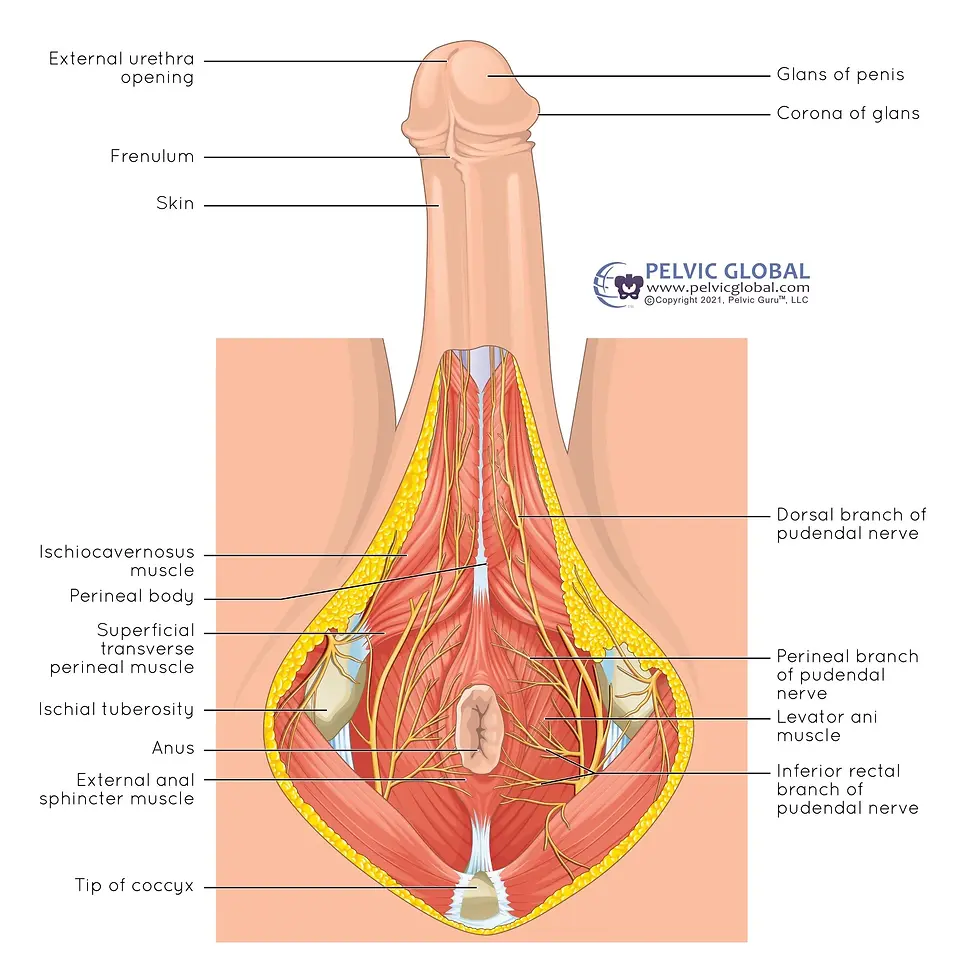
Before surgery, we use an internal assessment to fully evaluate your recruitment, coordination, and endurance. This is how you learn what a correct pelvic floor contraction feels like, before you need it. After surgery, we can't perform this same assessment for six weeks while tissue heals, which is exactly why doing this work ahead of time gives you a head start.
The First Few Weeks
Once your catheter is removed, leaking is normal and expected while your pelvic floor heals and relearns its job. PT starts gently here, focused on correct muscle activation, posture, and mobility work that supports circulation and healing. If you did pre-surgery PT, we pick your program back up. If not, we build one specific to you, starting now.
Learning the Right Muscles, the Right Way
Quality beats quantity every time. Most men accidentally clench their abs, glutes, or thighs instead of, or along with, the pelvic floor, and never know it. Your therapist may use biofeedback (a sensor that shows your muscle activity on a screen) or hands-on guidance to confirm you're engaging the right muscles, correctly, before adding volume.
Building Strength Where It Counts
Your program should target the moments where you actually leak, not a generic exercise sheet. For some men that's getting out of a car, bed, or chair. For others it's a cough or a sneeze. For a lot of men, it's a slow leak that builds all day and shows up hard around 4 p.m. Your plan gets built around when and how leakage happens for you, then adjusted as that pattern changes.
Tracking Progress, Together
Continence improves gradually, over weeks to months, and the pace is different for everyone. Expect a check-in every 2 to 4 weeks so your plan keeps moving with you instead of staying static.
"I became virtually 100% continent after only 8 weeks due to the exercises Ali taught me, and I couldn't be happier!" — Paul, Google Review
Sexual Function Matters Too
Erectile changes after a prostatectomy are common, expected, and worth talking about openly, not something to quietly manage on your own. The pelvic floor plays a direct role in erectile function, and it's part of what we retrain. Starting at 6 weeks post-surgery, we can talk about building an erectile recovery program into your home routine. It doesn't have to be your first priority. It doesn't need an apology, either. If it matters to you, tell your therapist, and we'll build it into your plan.
What Helps Most
Consistency with your home exercises matters more than time spent in the clinic. The daily reps are doing the work.
Give it time. Real progress here is measured in months, not days.
More is not better. Form wins over repetitions, every time.
Flag concerns as they come up. Lack of progress, new pain, new symptoms, bring them to your PT or surgeon rather than waiting it out.
The Bottom Line
Pelvic floor recovery after prostatectomy is well understood, and it has a strong track record. Most men regain good bladder control with time and consistent practice. Your PT team is there to guide the pace and adjust the plan as you go, not hand you a sheet of exercises and disappear.
If you have questions about your specific plan or progress, bring them to your next appointment. If you haven't started yet, or you're preparing for surgery and want to get ahead of it, reach out through our contact form and our team will match you with the right therapist at either our Fan or West End location.
Written by Alison Gallup, PT, DPT, OCS
Source: Milios JE, Ackland TR, Green DJ. Pelvic floor muscle training in radical prostatectomy: a randomized controlled trial of the impacts on pelvic floor muscle function and urinary incontinence. BMC Urology. 2019;19:116.

Comments